

I didn’t go into 2023 expecting it to be a year packed with non-stop banger game releases. I also didn’t expect to look on as the hobby I loved would be quickly and unceremoniously gutted through massive industry-wide layoffs. 2024 is already looking to be more of the same—high-profile, long, well-reviewed games coming out every couple of weeks, and daily news stories about more layoffs.
While there are many factors that led to this climate (and in-depth reporting about it in various news outlets and blogs), the biggest one that directly impacted me was the sheer amount of games that came out.
It was a genuine struggle to keep up with the big releases alone. But it would have felt wrong if I didn’t take the time to dabble with my backlog or venture into the somewhat lower-profile games I tend to gravitate to. I saw the impact of the deluge of games in the end-of-year podcasts I listened to as well, with many cast members admitting they just never found time for game X or Y and the conversation being less interesting as a result.
It didn’t help that so many of the big games were very, very long. I spent over 70 hours playing through Final Fantasy XVI only to conclude that I wished it was about 50 hours shorter. I spent 60 hours playing Diablo 4 only to finally admit that Diablo is simply not for me. By the time I’d reached the end of Lies of P, 40 hours in, the last few levels had stripped away all the fun, leaving me with a pretty sour take overall, despite the praise it received elsewhere. And to discuss these games at a critical level means playing them somewhat thoroughly. It was simply impossible, unless you cut out everything else in life, to come out of last year with a truly authoritative list of games (if that were ever truly possible).

I’d like to say I tried pretty hard to get close though. At least, to a list that reflects myself and my tastes, and something that you can read and enjoy, knowing I didn’t make a huge list of concessions in the process.
Baldur’s Gate 3 is probably the biggest gap. It’s the first game since the original Dragon Age in this style that I started and really enjoyed. But to play it in a way I’d be satisfied with in 2023 would have meant a playthrough in both single-player and co-op. I got the farthest along in co-op, but it felt so chaotic and difficult to follow that I knew I had to play it by myself at my own pace as well. That’s a good 200 hours of time that I had no hope of finding in 2023.
Outside of that, I never got around to Cyberpunk 2077’s 2.0 update and Phantom Liberty DLC. Nor did I end up making time to play through Chants of Senaar and Dave the Diver. I really want to play Octopath Traveler 2 one day, but that is going to have to sit pretty deep in the backlog for now.
Could I have made better decisions about which games I chose to play? 100%! Starfield says hi.
I knew I wouldn’t like the new Layers of Fear remake, but I played it anyway.
I probably played less Destiny 2 in 2023 than I did in years past, but that doesn’t mean I stopped.
All of this is just to hammer home that while the following top 13 (!?) is by no means a definitive list, it is my definitive list. I didn’t play every game I wanted to, but that would be impossible in any year. In putting this list together, it includes the process of venturing down all the weird B-game cul-de-sacs I can’t help going down. And yes, that’s right, I’m breaking from my usual top 10 list. I spent hours trying to figure out which one of four games would take the 10th slot, and ultimately, I’d rather just celebrate a few more games than stick to the rules.
13 – Robocop: Rogue City
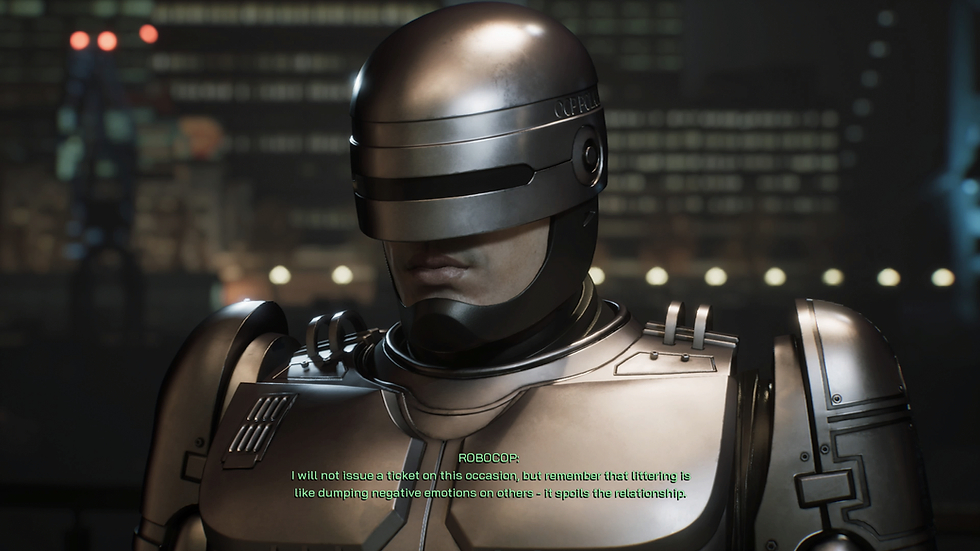
I watched Robocop for the first time last year. It was one of the wilder blind spots in my film knowledge, but a lot of scenes and lines were familiar. Blame it on a mix of cultural osmosis and flipping through TV channels in the 90s.
Either way, I couldn’t have picked a better time to have the movie fresh in my memory, as we got the best Robocop game ever made with Robocop: Rogue City. This game is full of big-hearted, fun, ambitious ideas, while still managing to kind of feel like an Xbox 360 era first-person shooter.
There’s still a good bit of satire and cynicism here, but considering a series of mini-open world zones and sidequests can make the game somewhere between 10-20 hours long, I think the devs made the right choice in lightening up the tone a little. Each quest gives you the opportunity to uphold the law or gain the public’s trust. In my playthrough that meant Robocop made friends, went to therapy, danced for kids, and saved a cat from a burning building.
And when the shooting starts? Oh boy is it an absolutely absurd bloodbath. Robocop’s signature gun gets so overpowered by the end it makes Halo 1’s pistol and Dead Space’s Plasma Cutter look like pea shooters. But more importantly, they made it feel like you are Robocop in the same way that Arkham Asylum nailed the feel of embodying Batman.
12 – Tchia

Tchia starts as a charming little adventure in which a young girl gains superpowers and fights to save her family on a tiny island nation. It’s inspired by the community and culture of New Caledonia, where the game was developed. You’ll spend a lot of time early on sitting down with little communities singing and playing instruments, or just slowly wandering around the wilderness, taking in the sights. It’s a bit quaint, and maybe even a little predictable and sappy. If you watched a trailer, you probably know what I mean.
Where Tchia quickly won me over was in the many ways it shrugged off that initial take. Tchia has some surprising edginess to it, harkening back to family films of the 80s. One moment you’ll be sitting on a hill overlooking an island, singing and playing guitar with a new friend; the next, you’ll be cutting the head off of a chicken and watching its body keep walking around, squirting blood out of its neck stump. Much of the storytelling is like this—sincere slices of life juxtaposed with absurd, scary, shocking bits of dark humor—and it really adds a unique identity and spirit to the experience.
The core gameplay is essentially the traversal elements of Breath of the Wild with an extra layer of fun. Some simple touches make it a real blast to get from place to place. Tchia can possess animals and objects in the environment for a limited time, and it feels amazing to butt-slide down a mountain, launch off a hill, possess a bird in mid-air, and then take off flying towards the next objective. Every tree in the environment can be climbed and then used as a slingshot, allowing you to ping-pong across the world and get some serious air.
On the surface Tchia comes off as a bit of a low-budget, cozy take on Zelda. Digging in I found something far more delightful: a pleasantly short, beautiful adventure with a flair all its own. Tchia feels like something that’s only possible when the games industry is truly diverse and worldwide.
11 – Cosmic Wheel Sisterhood

Cosmic Wheel Sisterhood didn’t immediately win me over. It’s a visual novel game that’s lacking a lot of the quality-of-life features I’ve come to expect in these kinds of games. Developers of visual novels, listen up: you have to include a way to go back through at least the last few minutes of text! When I read a book, if I forget who a character is or zone out briefly and misread a line, I can always jump back a bit.
That issue, plus some pretty poor controls in the Nintendo Switch version of the game, made it a bit of a start-and-stop affair for me. I almost didn’t stick with it.
I’m so glad I did though, because Cosmic Wheel Sisterhood’s choice-based narrative was excellent.
You play as Fortuna, an immortal oracle witch who has served 200 years of her 1000 year exile. Finally becoming fed up with her solitude, she summons a Behemoth, a sort of cosmic god that helps her to find her freedom and build a powerful tarot card deck.
From there you spend the majority of the game getting visitors to your little space witch hut. They almost all show up because they learn of your new deck and divination skills, and they all want a reading from you. Each card is custom made by the player, combining different backdrops, characters, and items to craft a scene that takes on particular properties. When you draw a card, you’re then given a few choices for how to interpret the card for the visitor.
The story of Cosmic Wheel Sisterhood plays around with vast, incredible power. This diverse, wonderfully-woke cast of women ride around the cosmos on broomsticks reshaping civilizations, and you just happen to be one of the most powerful of the bunch. The end result is some wild freedom to shape the story and make it go in a variety of directions. It’s clear that no two playthroughs of this game are alike, and when I finished it, despite my issues, I was seriously tempted to jump right back in and start again.
10 – Amnesia: The Bunker

I don’t think I ever want to play this game again. Just thinking about it stresses me out.
Amnesia: The Bunker takes place during World War I in a dark, dingy, seemingly abandoned bunker. Someone has already tried and failed to make an escape, leaving you with clues of how to blow your way out of the collapsed exit. You’ll need the plunger for a detonator and the dynamite itself, which are locked away deep in the bunker. The biggest problem? A gas generator keeps the lights on for a limited time, and you’re not alone.
Let’s count the ways this game is absolute nightmare fuel. You have to venture out into the bunker to scavenge for supplies and clues. Each gas tank you find provides about 15 minutes of power, illuminating much of the bunker. For the darker areas, or when the power goes out, you have a very loud rechargeable pull-cord flashlight. There are dark holes everywhere, creating a network through which the monster can hear and pursue you. If you get hurt badly, you leave a blood trail that the monster can sniff out. The only relatively safe place is the generator room, where you can shut and lock the doors before the monster catches up to you.
The stresses of limited time, limited supplies, a deadly monster, and a maze-like environment are almost too much. What makes the game so engaging and kept me going was how physical everything is. This isn’t some cheap haunted house walking sim, it demands creative thinking from the player. It’s an entire game of Far Cry 2’s grenade-rolling-back-down-the-hill moment.
I’ll give one small example: some of the bunker doors are made of wood. If they’re locked and you have a grenade, you can blow them open instead of hunting down a key. It’s a very logical solution that simply wouldn’t be possible in most games, but it also comes with a harsh consequence, as the monster will absolutely hear all the noise you made.
9 – Lords of the Fallen (2023)
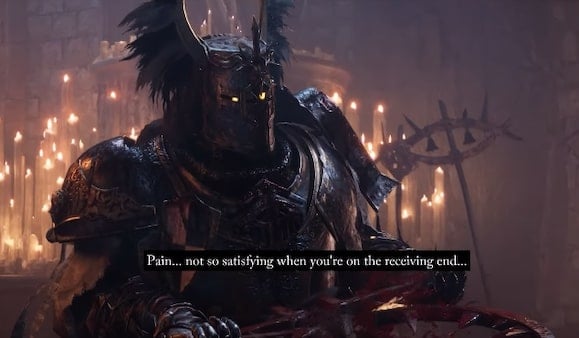
I wrote at length about Lords of the Fallen already. In that article I spent much of it doing backflips trying to explain and justify why I thought this game was deserving of attention. After writing that piece I finished Lies of P, and came away even more convinced that I was backing the better Souls-like. Lords of the Fallen got a lot of bad reviews, and it’s only because my wife loves watching me play these games and pushed me that I even gave it a chance. But now I can honestly say it’s a game I loved, and I want to focus on what makes it so great, rather than trying to make justifications.
Simply put, Lords of the Fallen has one of the most impressively-designed worlds in a game of this genre. I come to Souls games more for the exploration than the boss fights, and Lords of the Fallen seems to agree with that sentiment. I spent much of the game absorbed by the intricate level design, jumping between the physical world and the umbral dimension in order to find secrets. The various systems—two worlds layered on top of each other, the umbral dimension’s ever-increasing difficulty, and a limited supply of placeable save points—all come together to create a constant sense of risk vs. reward.
And then, when the game did throw a boss fight my way, I was consistently impressed by their design. Many of the bosses here felt impossible and cheap at first, as is usual with this genre. But as I tried and retried to defeat them, the path to learning and overcoming the odds was always so much faster and more satisfying than it tends to be in Dark Souls or Elden Ring. In those games I’m usually summoning help or cheesing a boss with spells, simply because the learning curve is so oppressive that learning to correctly dodge and parry everything seems insurmountable. It’s hard to justify learning an Elden Ring boss’s 900 different attack patterns when there are 50 more bosses standing right behind them.
I’m not saying I think Lords of the Fallen is better than Elden Ring, but it does offer a balance to this genre that I found to be really refreshing. I’m looking forward to returning to the Lords of the Fallen later this year, when it will surely be even better.
8 – Hi-Fi Rush

I spent an embarrassingly long time trying to get my Xbox Series X to play nice with Hi-Fi Rush. Modern consoles and TVs introduce such a complicated layer of settings piled on top of settings that I still never feel like I have it quite right. That said, I spent quite a long chunk of Hi-Fi Rush struggling to enjoy it because of the small bit of audio lag I had accidentally introduced (it turns out Dolby audio was the culprit!). That made it impossible to keep a decent combo going. When I finally solved the issue I was able to do that tricky triple-dodge move I could never get right. Suddenly I was finishing some fights with an S-rank. Finally, this fantastic blend of rhythm game and Bayonetta combat came together.
Hi-Fi Rush has the energy of a Saturday morning cartoon, complete with a derpy-but-lovable protagonist, some unquestionably-cool sidekicks, and a cast of colorful villains. The whole presentation looks unbelievable, with a vibrant cel-shaded effect that shows just how far we have come since Jet Set Radio. My jaw was on the floor for the vast majority of the game’s story beats because it always looked so incredible.
But the real joy of Hi-Fi Rush is when the music is building and building as the game throws an army of enemies your way. Getting locked in with the beat and internalizing all the enemy attack patterns turns this into a game where you get goosebumps every time a fight starts.
If I had one major complaint it’s just that the level design and platforming sections between the fights can be pretty dry. I’d love to see a sequel build on everything here to make a game that’s more consistently exciting and has less of a stop-and-start structure.
7 – The Talos Principle 2

For me, the original Talos Principle filled the hole left in my puzzle-solving heart from finishing The Witness. I wanted to be back on some Myst-like mystery island solving dozens of devious puzzles, and Talos Principle was just the ticket. It was a great time, offering its own flavor of puzzle gameplay and an extra layer of sci-fi storytelling and philosophizing.
The Talos Principle 2 makes the first game feel like a demo, while still building upon a great foundation. It’s still ultimately a series of puzzle rooms, where you use various devices to redirect laser beams, place boxes on buttons to open doorways, and turn on fans to jump to higher areas. However, that premise is enhanced with creative new mechanics, a more open-world structure, and a much-enhanced story presentation featuring a loveable cast of characters and a deeper level of philosophical choices to make.
The end result is a game that pulled a sort of magic trick on my brain. Between finding notes and conversations discussing climate change, AI, societal structure, art, and the meaning of life, you spend the majority of your time using your brain in a very different way to solve puzzles. That blend caused my brain to wander and think deeply about the state of our world, what it means to be part of a community, and what could be done to make our planet a better place. It’s one thing to say a game makes you think, it’s quite another to say a game makes you reflect deeply on yourself and the world around you.
6 – Dead Space (2023)
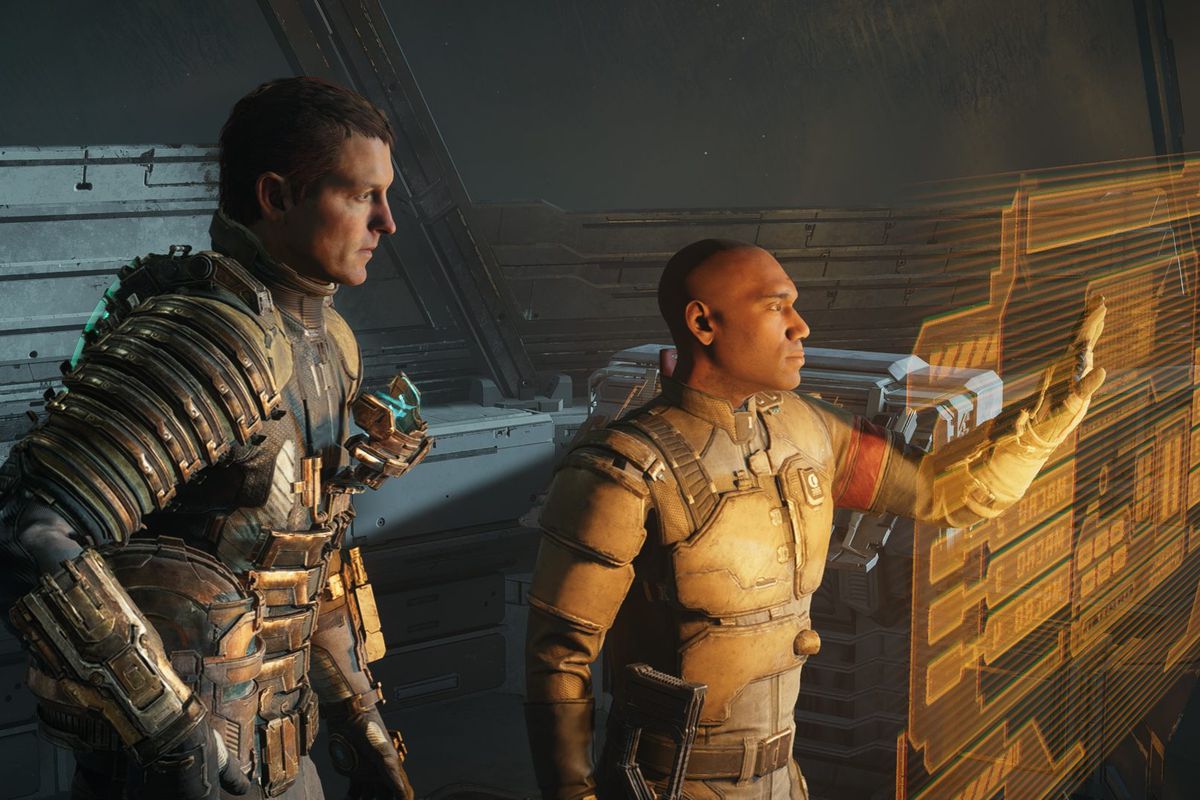
The most unnecessary remake ends up being the new, definitive way to play one of my all-time favorite games. Dead Space was already great, and 15 years later it hasn’t really aged too much outside of the graphics and a few weaker sections. Despite this, the remake managed to improve the graphics, rethink those weaker moments, AND make about a dozen more smart updates to truly revitalize and improve upon the original.
I was never a fan of silent protagonists, and with the way the story went in the original game, the mute Isaac Clarke never made any sense. Giving him a voice and personality in Dead Space 2 humanized him and dramatically improved the storytelling. Giving him a voice in this remake was a risky move, but by keeping the dialogue minimal and maintaining that same personality they developed in Dead Space 2, it’s an inarguable change for the better.
Then there are the little tweaks and changes that weren’t asked for, but made the game feel fresh. Weapons were rebalanced in a way that made putting away the Plasma Cutter feel viable. The upgrade system is expanded and lets you unlock specialized features for each weapon. The ship layout is more cohesive, with the entire Ishimura now feeling like one large location instead of a series of levels. The list goes on and on.
But the most surprising change takes inspiration from the director system in Left 4 Dead. Each room is designed with a variety of ways to fuck with you, and the game takes your behavior and ammo/health levels into account before deciding to throw a huge battle your way or simply shutting out the lights. The unpredictability makes it every bit as scary for returning players as newcomers.
5 – Resident Evil 4 (2023)

I have been a Resident Evil fan since 1996, so I know how unpopular this opinion is: I don’t really like the original Resident Evil 4. When I finally got around to playing it I had an okay time with it, but the initial village sequence was such a high point that it always felt like it went downhill from there. Combine that with the overly silly story, stiff controls, and extremely linear level design, and I just never vibed with it.
For fans, the 2023 version of Resident Evil 4 is just another way to revisit a game they already loved. For me, this remake takes a game I didn’t like very much, and turns into one of my all-time favorite entries in the series.
I’ve heard a lot of people make light of the changes, acting as if this is more or less the same game with a new coat of paint. But what Capcom did here is actually pretty remarkable. The controls build on the remakes of Resident Evil 2 and 3, allowing you to aim and move simultaneously, as well as quick swap weapons without jumping into a menu. However, with Leon being more of a highly-trained soldier, they also bring in the CQC elements of the original RE4. It’s ridiculous that you can suplex and roundhouse kick zombies, but it’s also very fun, and made even more so with the addition of a knife parry ability.
When zombies pour in from every direction, this game sings. While the village sequence was still amazing (and quite difficult), I found myself experiencing that same hectic rush throughout the game. Even when I was dying I was having a blast, desperately navigating the push-and-pull of running out of ammo, breaking my knife to parry a chainsaw attack, and throwing explosives in a last-ditch effort to gain some ground.
What really brought it all home for me though was the pitch-perfect change in tone from the original game. It’s still very goofy and over-the-top, but Ashley is charming and capable (no longer being dropped into dumpsters or subjected to cringey upskirt shots), Leon is a lovable dork, and the atmosphere is just a few degrees closer to the horror of the originals.
4 – Cocoon
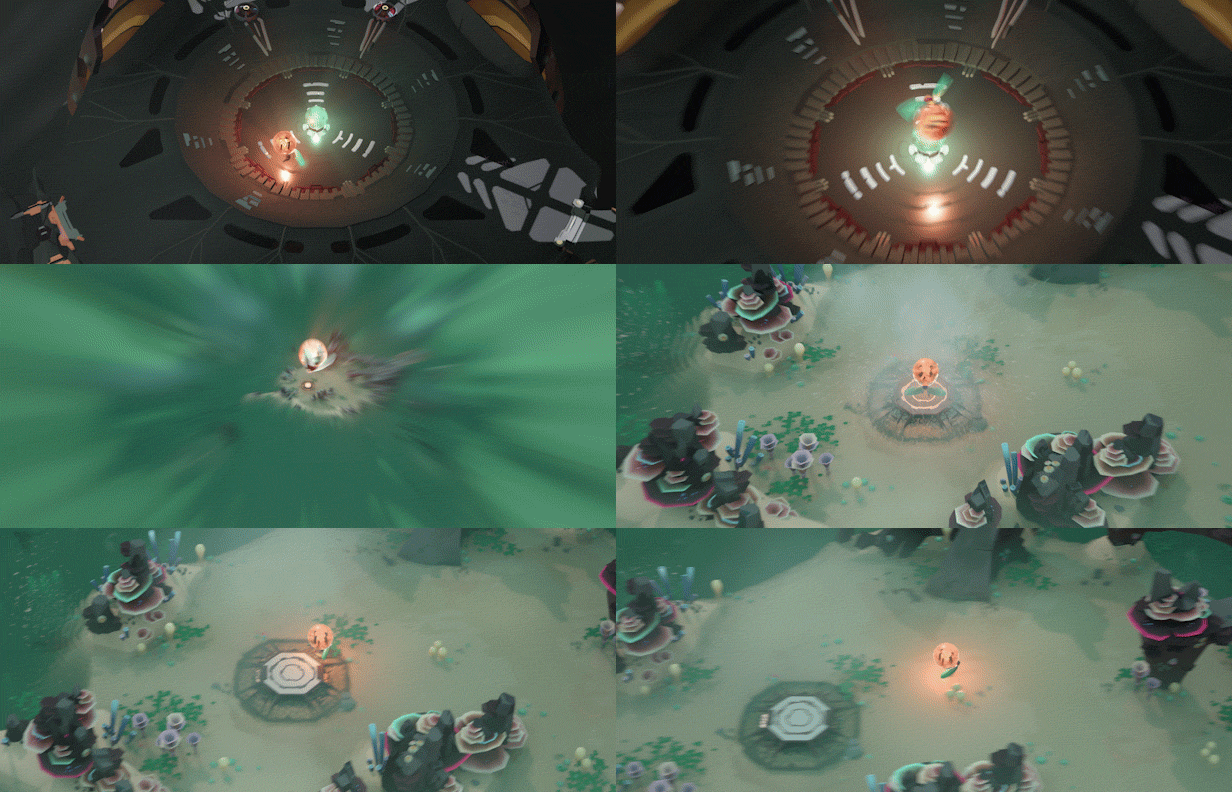
Cocoon is one of the most impressively-designed puzzle games I’ve ever played. Without a word of dialogue, it throws you into its strange world of bug creatures and glass-ball-universes. Everything is perfectly communicated to the player through clever visual cues, and you don’t need more than one button and an analog stick to play.
For the first couple of hours, the game was so good at this simplicity and communication that I fell into a bit of a puzzle-solving fugue state. It was almost too easy, but it was also so satisfying to quickly look at a puzzle and immediately see the answer, solve it, and move on again and again. The trick is that these are clever puzzles. They’re never mindless, so even when you are barreling through a bunch in a row, it feels exciting.
Eventually the ideas build and build until Cocoon gets a bit mind-bending. The core premise revolves around these little universes that you can pick up and carry around, but then drop into a plinth and dive into. By carrying one of these universe orbs and diving into another, you start to create worlds within worlds. There were a few puzzles that had me stumped for a bit towards the end, but it’s a much more gentle climb in difficulty than something like the scribbling-in-notebooks-at-2AM energy of The Witness or Tunic.
This is a game I’m going to keep in my pocket for those non-gamer/game-curious, puzzle-loving friends and family members. It’s an easy recommendation.
3 – Remnant II

For most of the year, Remnant II was my number one game of the year with a bullet. It wasn’t even close for quite a long time. Building on the original game, Remnant II is a 3-player cooperative third-person shooter with Dark Souls elements. Remnant swaps swords and shields for guns, but you still have a dodge button, stamina meter, limited healing items, and massive bosses with tricky mechanics to learn.
The core gameplay is fairly unchanged from the first game. The biggest improvements are in the build-crafting for your character, and the absolutely wild amount of bespoke concepts sprinkled into the worlds you explore. You start in a hub town with options to purchase upgrades and talk with all the characters, and then you set out into various worlds connected by a giant magic crystal. Every area is hand-crafted, but every player’s starting world is random. When you load into a world for the first time, the individual dungeons inside are randomly selected from a larger pool.
This means a second playthrough of a world has the potential to be quite a bit different from the first. And while there are dungeons that have you fight through a typical maze and then battle a relatively standard boss at the end, Remnant II rarely keeps its gameplay that simple.
Simply put, the encounters in this game are unlike anything I’ve ever seen in my years of co-op gaming. There is so much unexpected variety, so much hilarious fun, that it puts to shame most of what’s in all of these huge, expensive live service games, Destiny 2 included. Most of Remnant II feels like a lighter, more approachable version of a Destiny 2 raid, except even then Remnant II is doing absolutely wild creative shit that you’d never see in the former game.
At one point our group was exploring a castle filled with vast libraries, dark cellars, and flying zombie knights with rainbow wings. We wandered into one of the smaller chambers. Before us was a winged statue sitting at a table with a second chair. One of our teammates sat down and started playing a tricky take on tic-tac-toe. For ten minutes or so, we all just hung out in this room trying to win the game and unlock a door.
That’s just a small and relatively tame example of how Remnant II tends to go off-script. There are complicated secrets tucked away for those who are willing to roll the dice multiple times and get the right set of random worlds. An entire character class was locked away using methods that only community dataminers could find. And everything in between, available to the average 3-player group, is every bit as creative and exciting.
2 – Alan Wake 2

Alan Wake 2 is basically catnip for all of my particular interests. It’s a survival horror game, one of four I included on this list. It’s heavily inspired by David Lynch and Twin Peaks with an added sprinkle of the first season of True Detective. It builds on Remedy’s connected universe of sci-fi and horror by connecting Alan Wake to their previous game Control. It’s filled with elaborate scripted sequences, combining gameplay with live action footage to create horribly effective jump scares and hilariously amazing musical sequences.
If you’ve ever played a Hideo Kojima game, whether you like him or hate him, there’s no denying that he puts a unique fingerprint on his games. In that sense, Alan Wake 2 feels like a Hideo Kojima game more than anything I’ve ever played outside of Metal Gear Solid and Death Stranding. And I don’t mean that the game has long rambling cutscenes or goes off on incredibly corny tangents. What I mean is that Sam Lake and the team at Remedy have authored a piece of art that bleeds with their particular interests and ideas. We may never get a game like Alan Wake 2 ever again, it is a truly special and beautiful thing.
With that level of praise, you may be wondering why this game is in the number two spot in this list. And for as much as I absolutely adore this game, as much as I respect how outrageous it is, and as much as I know this is absolutely my favorite Remedy game, it does have some serious flaws. Alan Wake 2 is a near-perfect game nearly drowned by a pretty annoying lack of polish. It’s beautiful and expensive-looking, but it’s not nearly as refined as some of the survival horror entries I mentioned earlier.
In my time exploring Bright Falls, I ran into areas where enemies would endlessly respawn and drain my resources, discouraging the exploration that makes up some of the best parts of the game. In hectic moments, where my character is intentionally slow and sluggish, I found myself betrayed by weird control and animation glitches that would cause my character to stop reloading or melee the air when I wanted them to shoot. Worst of all, I almost missed one of the live-action sequences because the video simply wouldn’t load no matter what I tried.
These issues will hopefully be cleaned up in time, but I can’t deny they detracted from the experience. That said, I still absolutely loved Alan Wake 2. It’s a game I expect to return to again and again. And hopefully, with a few more patches, it’ll be the full-on masterpiece it comes so close to being.
1 – The Legend of Zelda: Tears of the Kingdom
So here’s the thing: I didn’t love Breath of the Wild. I liked the core ideas. I liked cooking meals, climbing hills, and discovering shrines. I didn’t even mind the weapon durability that seemed to be the ire of even the game’s biggest fans. My issue was that everything else about it was painfully boring. Every time I was forced to talk to a character and advance the story felt like absolute torture. The main quest of conquering the four divine beasts and defeating Ganon was such a drag that I fell asleep playing the game more times than I can count.
By that measure, Tears of the Kingdom feels like a completely different game. From minute one, this sequel has the elements that were so sorely lacking from the first game: drama, stakes, good characters, and fun writing.
I have a lot of really fond memories of Ocarina of Time, the infamous Zelda game for Nintendo 64. I have no idea how it holds up now, but playing it as a kid, the thing I remember most was the thrill of it. I remember getting goosebumps from the music and boss fights. I remember playing the final battle against Ganon again and again because the visuals, music, gameplay, and storytelling all came together to create genuine excitement and drama.
That was the piece of the formula missing from Breath of the Wild, and it’s the major change infused into every bit of Tears of the Kingdom. The end result is a game that gave me over 100 hours of adventure and fun, with pockets of big-hearted, beautiful storytelling through both gameplay and cutscenes. There are sequences in this game, especially around some of the big story reveals, that genuinely left me breathless.
Boss fights are big and exciting, bolstered by incredible music and fun new mechanics. The world is the same one from Breath of the Wild, but ripped apart with a remixed ground level, islands in the sky, and a vast underground plunged in darkness. It’s easily the most impressive open world in a video game. Despite the millions of dollars that Ubisoft throws at every Assassin’s Creed game to create impossibly huge worlds, those games can’t hold a candle to the experience of diving from an island in the clouds down into a massive hole carved into the earth, plunging into the deep darkness of the depths.
Link’s new suite of abilities are so fun and so empowering, that it makes everything that was kind of slow and boring in Breath of the Wild far more immediate and exciting. The physics and the ability to create all kinds of weird cars and airplanes make this little Switch game a real technical marvel. Everything behaves how you’d expect, which, in a video game, is so uncommon that the end results are usually really surprising. Plus, I really loved Banjo Kazooie: Nuts & Bolts, and this game is basically a spiritual sequel.
I included the trailer for Tears of the Kingdom above because I want you to rewatch it. I watched it again after finishing the game, and what’s so fascinating about it is how there isn’t even a fraction of false advertising within it. That’s just what Tears of the Kingdom is like. It not only lived up to the impossible hype, but it shattered my very serious doubts, quickly becoming one of my all-time favorite games.
 Red Ring Circus