
Back in 2015, I wrote a 740 word unpublished rant about the slow walking speed of Everybody’s Gone to the Rapture, a narrative exploration game set in an idyllic English village harboring a dark mystery. I really enjoyed the game, but found the pace of the first-person exploration so slow that it bordered on sadism. If I saw something interesting in the distance, I had to weigh the value of a shiny narrative revelation against the time I’d spend counting the steps to get there.
I bring this up because it was all I could think about while lethargically shambling down the hallways of Fort Solis, a new narrative exploration game with a dark sci-fi setting.
You play as Jack, a blue collar worker in a colony on Mars. When Jack and his co-worker Jessica receive a distress signal from Fort Solis, he drives off to investigate. From there, you’re left to explore the base and figure out what happened, while Jack and Jessica try to break the tension over the radio with jokes and anecdotes of the past.
Before long you learn that something bad has happened at Fort Solis, and, through various computer logs found all over the base, you begin to piece together a narrative. Along the way, security clearance, malfunctioning machinery, and signs of sabotage create a laundry list of goals for Jack to overcome. One hallway in particular, with security clearance from level 1 to level 5, seems like a place you’ll be returning to before the end.

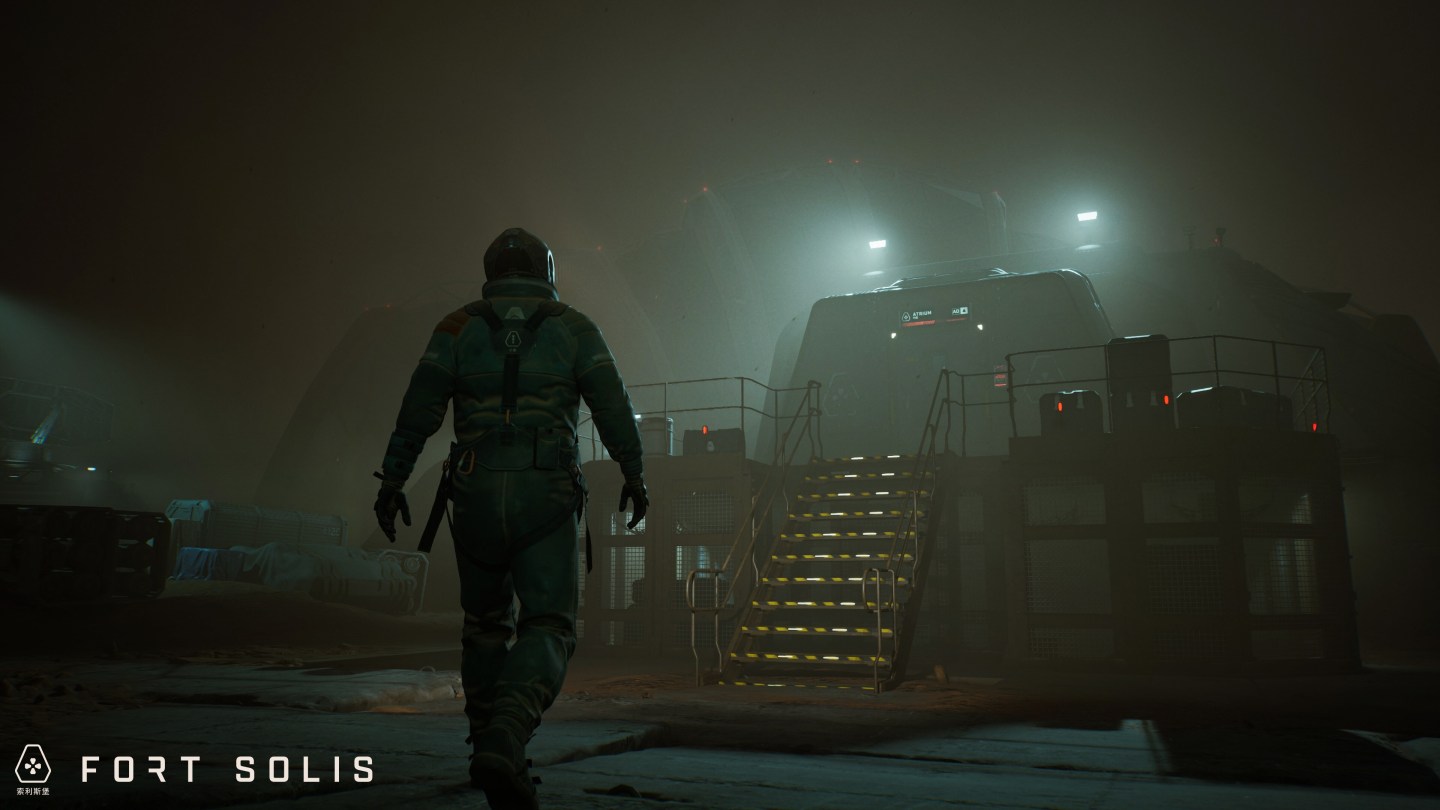
You spend the majority of the game walking from one story beat to the next. As Jack and Jessica get an idea about where the next clue might be, you’re left to examine the environment and find it. The design of the base itself is the main source of guidance here. Fort Solis’s world design is detailed and functional. It feels lived in, and it’s clear a lot of time was spent getting that sense of place just right. That means that when you’re trying to find the Drill Bay, you just look for it the same way you’d look for the bathroom at an airport—you read the signs in the environment.
It’s a simple thing, but the sense that you’re navigating a place people actually live and work in is actually quite rare in games. There are so many competing interests, from gameplay, to objectives, to development cost and time constraints, that few game worlds actually get that right. The attention to detail here also plays into the overall vibe of the game—a grounded, dark, sci-fi world reminiscent of the film Alien.
That said, good luck if you miss a context clue or get lost in any way, because as well-realized as the environments and graphics are, the actual gameplay isn’t nearly as strong. An in-game map gives you a view of the entire facility on Jack’s tiny wrist display, but it’s pretty confusing and painful to use. Early on, this left me wanting to explore and find the next goal on my own, but the aforementioned walking speed put a stop to that pretty quickly.
Jack strolls around at such a sloth-like pace that taking a wrong turn can feel as punishing as dying to a boss in Dark Souls. There have been complaints about games like Red Dead Redemption 2 for their deliberate pacing, but for all the times I struggled to navigate Arthur Morgan up a few steps onto a porch, it was never as unpleasant as simply turning Jack around in Fort Solis. He truly feels like he’s stuck in quicksand.

It gets a little ridiculous as the danger around him grows. Jack walks slower than my own casual walking speed in real life, but you better believe I’d pick up the pace a little if I were in a dark, creepy installation on Mars. Jack’s gait never changes throughout, and eventually it starts to impact the suspension of disbelief.
When the tension ramps up, the game relies on QTE sequences. These QTE prompts blend in with the action, appearing in confusing parts of the screen. I missed them often, but failing most of them doesn’t change the story in any way.
All of this plodding, low-impact gameplay could be excusable if there was a strong story to go along with the strong world design. Unfortunately, it really doesn’t amount to much. The story is really promising at first (with a really strong performance from Troy Baker as one of Fort Solis’s residents) but all of the gas is in the first hour or two. From there, the game coasts in neutral without any new ideas or revelations. Everything plays out exactly as advertised, with twists or turns to keep you intrigued.
Fort Solis could have been a great low commitment experience where you experience a spooky, vibe-y sci-fi story with minimal friction. It could have been a great palette cleanser between bigger games. But unlike Everybody’s Gone to the Rapture, which had a slow pace but rewarded the player with a compelling narrative, Fort Solis is a real head-scratcher. The game’s biggest mystery is, “why did I just spend the last four hours playing that?”
 Red Ring Circus